It’s Tuesday, March 31. Backlogs at private laboratories have ballooned, making it difficult to treat suffering patients and contain the pandemic. Read the latest from our science and technology reporters Alexis Madrigal and Robinson Meyer.
In the rest of today’s newsletter: When the coronavirus pandemic comes to Trump country, politicization can only last so long. Plus: What’s the deal with Oscar Health and COVID-19 testing?
*
« TODAY IN POLITICS »
(Patrick Semansk / AP)
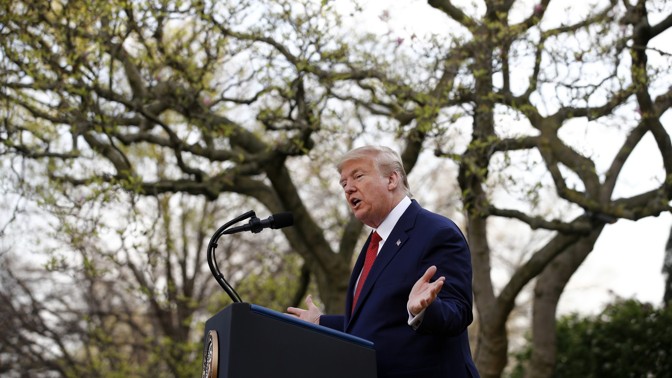
Thus far, the coronavirus outbreak has ravaged blue states and Democratically-leaning cities more than red states and rural areas (though the illness is spreading quickly). President Trump has spoken about the pandemic through a highly partisan lens, and has expressed belief that state and local governments haven’t been happy enough with the administration’s help, my colleague Peter Nicholas, our White House correspondent, writes:
Trump, though, is sensitive to anything he sees as ingratitude. If his administration sends planeloads of ventilators—a national resource—he wants a thank you, not a complaint about why it didn’t come sooner.
But as the virus spills widely across more red states, more Republican governors must figure out how to navigate the White House’s shifting moods.
But as the virus spills into more red states, Republican governors must figure out how to navigate his shifting moods. (That hasn’t stopped the president from taking credit for any positive development and parroting false news of progress to his base.)
The federal government can only do so much to enforce national restrictions, even if an aggressive one would help slow the pandemic’s spread. If the president wanted to enact a nationwide lockdown, akin to those in China, India and the UK, the way the federal government is designed prevents him from being able to do so.
On the economic front, drastic times call for drastic measures. Rather than shipping out one-time $1,200 checks to save the economy, here’s one idea for the Federal Reserve to stave America off long-term economic disaster, Annie Lowrey writes: Throw money out of helicopters. Really.
—Kaila Philo
*
« THE CORONAVIRUS READER »

(Getty Images / The Atlantic)
+ The president has promised a website devoted to coronavirus testing. He said Google would help; instead, it was built by Oscar Health, an insurance company closely tied to son-in-law Jared Kushner.
+ There’s some amount of political genius in the support the president has managed to maintain amid national calamity, Frida Ghitis argues: He’s somehow “transmuting his calamitous failures into political gold.” Here’s how.
+ Prisons are vulnerable environments for a pandemic. The new coronavirus will be a nightmare for those who might’ve been wrongly convicted.
You can keep up with The Atlantic’s most crucial coronavirus coverage here.
*
Today’s newsletter was written by Kaila Philo, a Politics fellow. It was edited by Shan Wang, who oversees newsletters.
You can reply directly to this newsletter with questions or comments, or send a note to politicsdaily@theatlantic.com.
Your support makes our journalism possible. Subscribe here.
 The Atlantic https://ift.tt/2R34ck1 March 31, 2020 at 07:00AM
Comments
Post a Comment