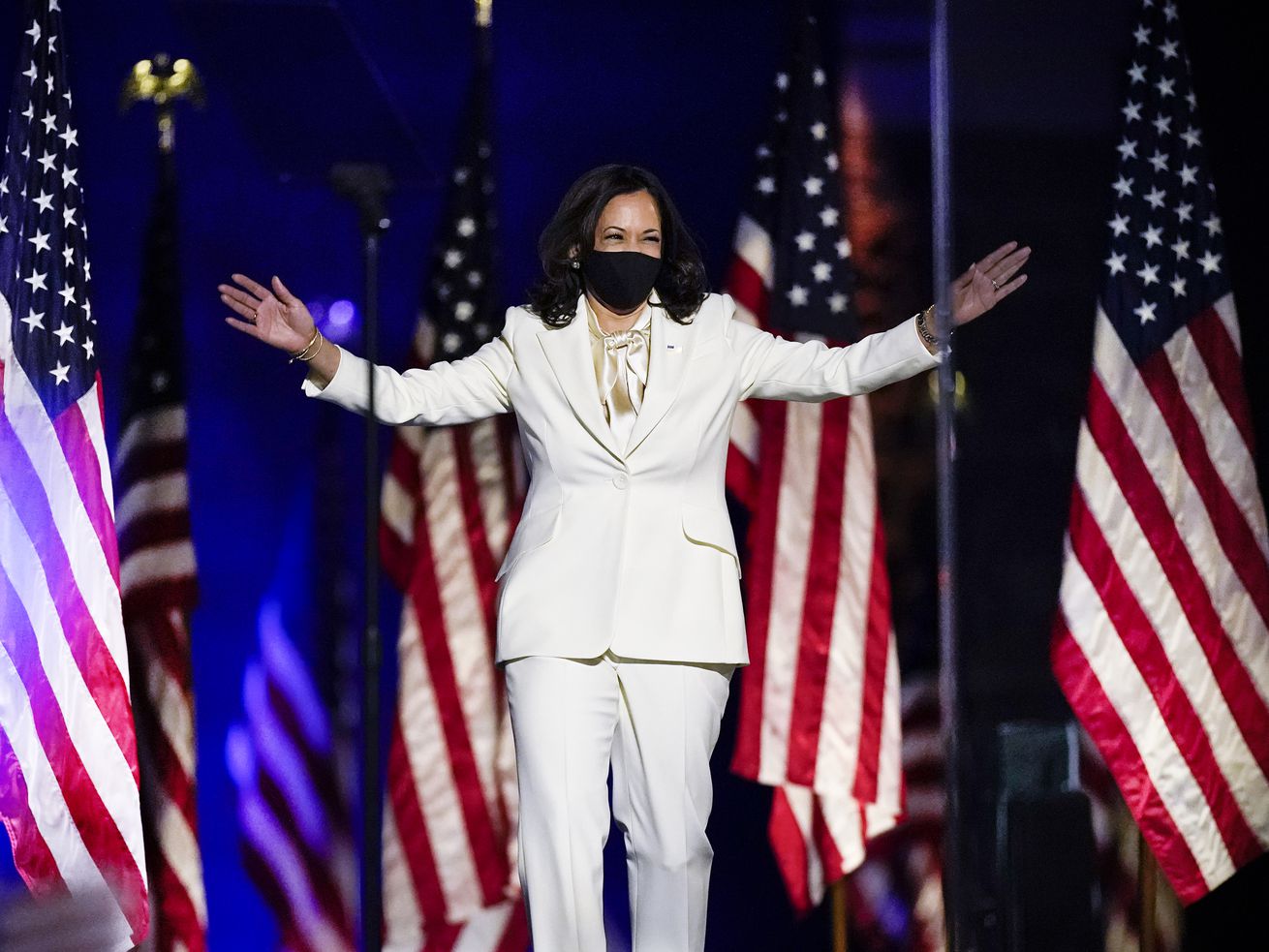
 Vice President-elect Kamala Harris arrives to speak in Wilmington, Delaware. | Andrew Harnik/AP
Harris wore all white for her victory speech, honoring suffragists.
Vice President-elect Kamala Harris began her acceptance speech with a strong statement: a white suit.
It was a striking message, sent before she said a word — the color was the one worn by suffragists as they fought for the right to vote.
Salutes to those women have been popularized by Democratic women in recent years — at this year’s State of the Union address, many lawmakers wore white in honor of the 100th anniversary of the 19th Amendment, which gave women the right to vote.
Many women lawmakers wore white during the 2017 and 2019 State of the Union speeches as well.
As Vox’s Anna North has explained, the suffragist movement was not an inclusive one; Harris herself likely would have been excluded from the famous Seneca Falls Convention of 1848 that helped pave the path to the vote for women. While it was founded on the work on nonwhite women, North notes, “in the drive to get states to ratify the 19th Amendment, white advocates wanted the support of Southern white women — and their husbands and fathers — and were willing to sacrifice Black Americans’ voting rights in order to get it.”
Those white suffragists made that sacrifice, and were ultimately successful in gaining the vote for themselves. Legally protected enfranchisement for Black women didn’t come until decades later — but to secure it, women of color created their own groups. And in those groups, they were able to, North writes, “work simultaneously against sexism and racism — pushing for federal anti-lynching legislation, for example.”
In many ways, Harris is the embodiment of the dreams and hard work of many of these women, white and nonwhite — not just because she is a woman, or a woman of color, but because she was able to take the stage thanks to the work of so many women, including modern women activists who have given their time and effort to register and motivate voters.
And while experts are still studying the electorate to understand who voted for whom, early exit polls suggest that women — particularly women of color — helped power Biden and Harris’s victory, whereas it appears Trump won among men.
Harris honored those women in her speech, thanking “all the women who have worked to secure and protect the right to vote for over a century.”
“One hundred years ago was the 19th Amendment,” Harris said. “Fifty-five years ago was the Voting Rights Act. And now in 2020, with a new generation of women in our country who cast their ballots and continue to fight for their fundamental right to vote and be heard.”
It was thanks to those women, Harris said, that the United States can now begin “to see what can be unburdened by what has been.” It was for them she wore white — and maybe even why she paired her suit with a pussy-bow blouse — to honor those who sacrificed and suffered to make her present possible.
Vox - All https://ift.tt/3eFZrHM November 08, 2020 at 05:30AM
Comments
Post a Comment